


How can psychology help us to better understand and address pressing environmental and societal challenges like climate change and the energy transition? How does the changing environment affect us, and how and when do we adapt to it? What predicts public acceptability and effectiveness of environmental policies?
Urgent questions like these are the focus of the Master programme Environmental psychology. The programme focuses on the interplay between human behaviour and their environment, and is taught by the world-leading Environmental Psychology group at the University of Groningen.
Through this programme, you will acquire theoretical knowledge and methodological skills to understand and address the human dimension of environmental challenges (e.g., climate-, energy-, food-related). This expertise is essential in attempts to limit environmental problems and their negative impacts, and to contribute to just and sustainable system change.
View the fact sheet for our master’s programme!
Governments and companies seek advice from environmental psychologists to understand the human dimension of sustainable development, and leading journals, such as Nature, stress the importance of the social sciences for solving these challenges. This master will equip you for job opportunities that focus on finding effective and acceptable societal solutions to these problems.
Visit the University of Groningen website to find out more about our programme.
Job prospects
What kinds of jobs do alumni of our master’s programme end up doing after graduation?
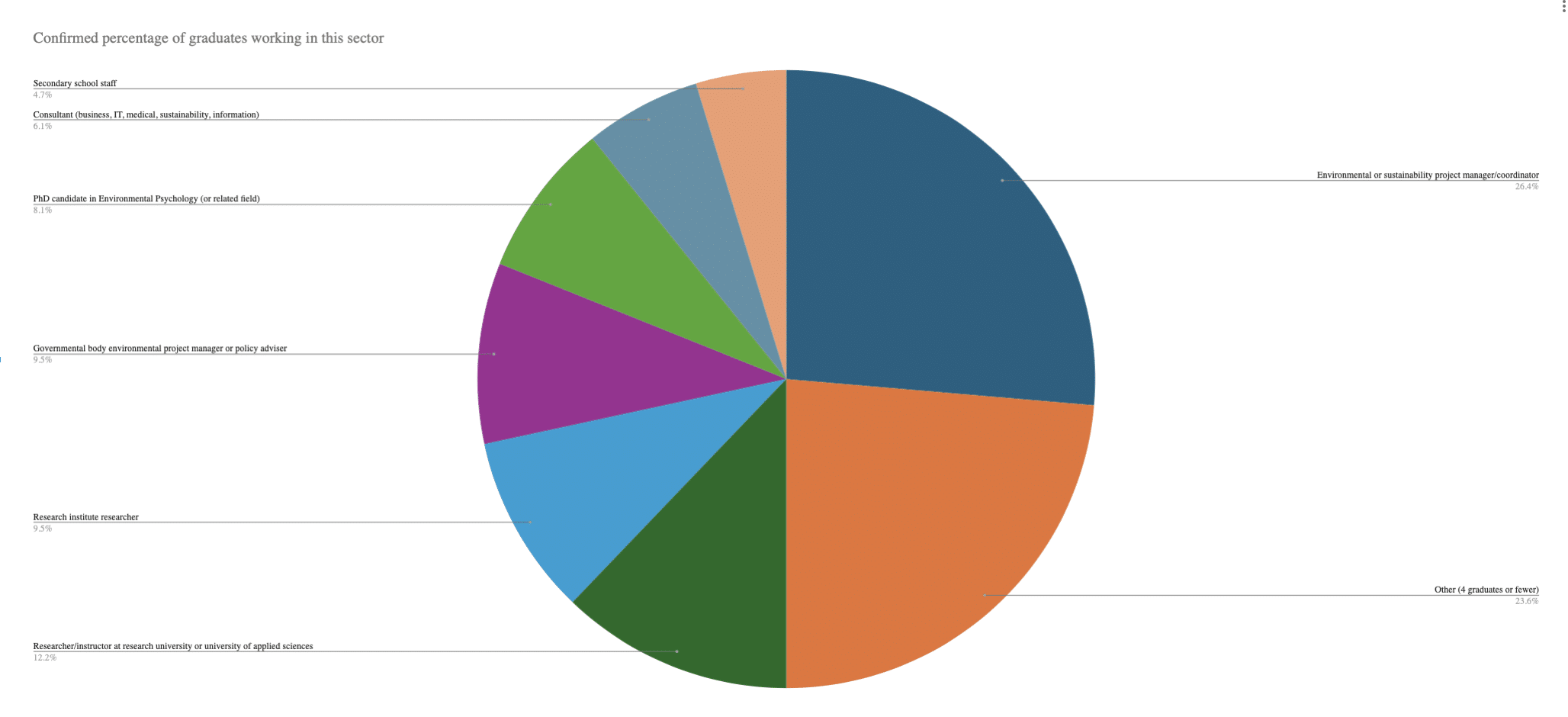
*confirmed
Alumni testimonials
 Nora Bjorn
Swedish, graduated in 2021
Current job: environmental strategist
1. What do you do in your current job?
I’m an environmental strategist at a municipality, and produce policies, serve as a project manager, and design interventions for behavior change like reducing food waste.
2. How do you apply what you learned in the EP master in your job?
I communicate information to different groups, and in order to do that, I have to understand why some behaviors occur and what steps we need to take to make change possible.
3. Why would you recommend this master’s programme to someone else?
No matter what type of job you plan on doing in the environmental sector, you will absolutely be able to put the knowledge you obtain during this master to good use. From knowing how to present information to different audiences to understanding what lies behind a certain behavior, this master will give you a perspective that will help you in your everyday working life.
4. Why did you choose to study environmental psychology?
I knew I wanted to work with environmental questions and do my part to leave this planet a better place than we found it. Psychology and people’s behaviors have always fascinated me, so environmental psychology was the perfect combination of my interests. It also gave me an edge in working life since environmental psychology is still quite uncommon.
5. What was the most interesting or valuable thing you learned during the EP master (especially in terms of things you apply in your job)?
I loved the course on designing interventions, because it gave me practical tools that I use now in my work. I have used the knowledge I obtained in this course on issues like reducing food waste in schools, motivating people to use public transport instead of driving, and encouraging people to eat plant-based foods instead of meat.
 Oula Terttunen
Finnish, graduated in 2019
Current job: behavioural scientist at Smart Innovation Norway
1. What do you do in your current job?
My current job as a behavioral scientist involves being in charge of applying (social) psychological and behavioral science methodologies in large EU projects that are related to energy technologies. I focus on stakeholder and user engagement — how to measure it, promote it, and study it to improve the effect of new energy technologies.
2. How do you apply what you learned in the EP master in your job?
In my current job I apply several environmental psychology methodologies as well applied social psychology methods, for example applying my understanding of people’s (environmental/energy-related) behaviors, attitudes, values, and motivations.
3. Why would you recommend this master’s programme to someone else?
Psychology and behavioral science and the energy & sustainability sectors are an excellent combination. I see there is demand for this type of knowledge and expertise. Even if sometimes companies do not know that they are in fact looking for environmental psychologists, their need for it is growing. And when people hear about it, I think many of them “get it”, even though they have not heard the term “environmental psychology”.
4. Why did you choose to study environmental psychology?
For me, it was a perfect match that combined my passions. In my third year of my bachelor’s in psychology, I thought to myself “if only there would be a way for me to combine my two passions: psychology and sustainability”. Not long after, I saw the master track advertised and my mind was made up.
5. What was the most interesting thing you learned during the EP master?
I felt that there was a good effort to work between faculties, like engineering and economics. This was very important, because it is great practice for the “real world” = working life.
 Lisette Anema
Dutch, graduated in 2023
Current job: Process leader for heat transition
1. What do you do in your current job?
I manage processes for different municipalities in the Netherlands for the heat transition, from policy making to participation projects.
2. How do you apply what you learned in the EP master in your job?
The heat transition is usually a very technical field, but everyone needs to make changes in their homes, so I am able to bring this behavioural side to policy and processes.
3. Why would you recommend this master’s programme to someone else?
A lot of our sustainability transitions are viewed from a technological perspective. In reality, we see that a big part of that is the behaviour and attitude change. Because it is still a developing and growing field, there is still a lot left to discover.
4. Why did you choose to study environmental psychology?
I really want to have a positive impact on my environment, and I felt like environmental psychology was the right fit for me because it is so focused on the sustainability transition. I love to work in interdisciplinary settings, which is very much required in this field.
5. What was the most interesting thing you learned during the EP master?
I think the most valuable thing I learned in the masters that I am still using in my work, is how to build interventions. Critical thinking and finding the fitting theories and data are extremely helpful.