Following the council of ministers meeting in The Hague on Friday, 15 December, an advisory report by the Wetenschappelijke Klimaatraad (WKR, Scientific Climate Council) for a Dutch climate plan was presented to demissionary environmental minister Rob Jetten (D66). The council, of which Environmental Psychology Groningen professor Linda Steg is a member, is advising the cabinet to prioritise the common good and embrace an all-encompassing perspective for a climate neutral and resilient Netherlands.
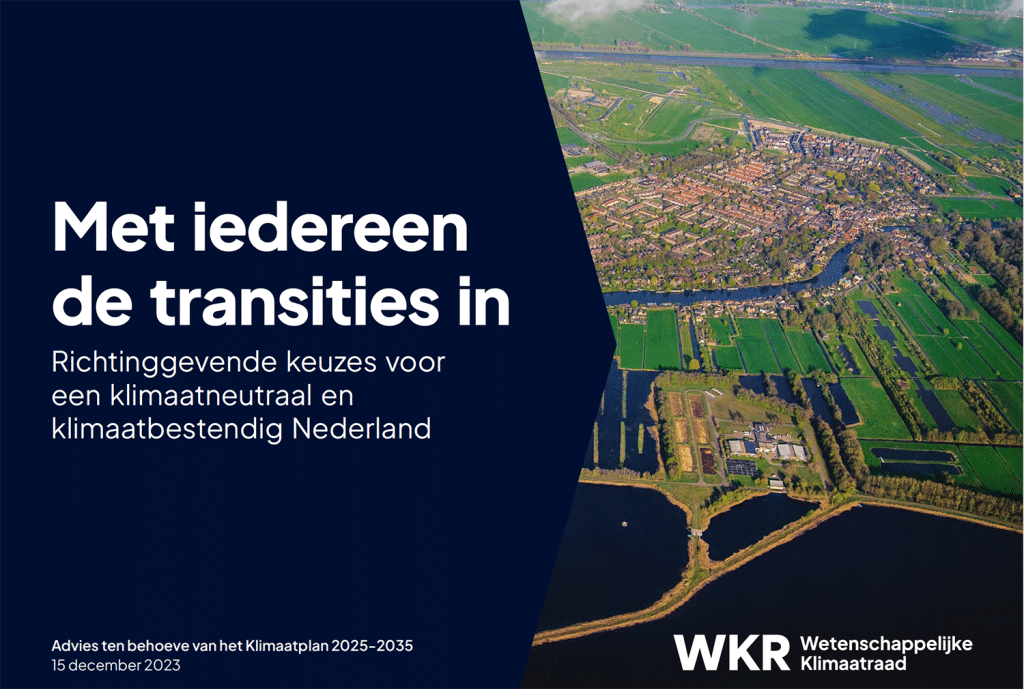
The Scientific Climate Council was asked to advise the government on the Climate Plan 2025-2035. The advisory report, titled “Entering the transitions together”, provides recommendations based on the state of climate science by the expert members of the WKR.
The WKR report, which was researched and created over the course of 2023, advises the cabinet to prioritise the common good and embrace an all-encompassing perspective for a climate neutral and resilient Netherlands.
You can read the report in its entirety (in Dutch) on the WKR site, and you can find a summary (in Dutch) of the report here.
The council calls for a stronger sense of urgency and more rapid progress toward climate neutrality and climate resilience, a system perspective and systemic approach to accelerate the transition for the long term, and entering into the needed sector transitions (food and energy in particular, and more circular systems) collectively.
A press release preceding the presentation of the WKR report points out that because much of The Netherlands lies below sea level, the nation with its many waterways and extensive water management system are proof of its vulnerability to climate change. The consequences of more extreme weather exacerbated by climate change are already being felt throughout the country, with droughts drying out agricultural land, more regular flooding, and extreme heat in urban areas.
The press release continues, stating that the Netherlands has much to gain from pursuing climate policy and taking more control over working and living together in safer and healthier conditions in the near and distant future. The next few years are crucial in this regard.

The Scientific Climate Council was asked to advise the government on the Climate Plan 2025-2035. The advisory report, titled “Entering the transitions together”, provides recommendations based on the state of climate science by the expert members of the WKR.
Jan Willem Erisman, chairman of the WKR, says that “Climate change is a monumental task of our time, but we are not powerless. Climate policy starts with an attractive and shared vision of the future. We need to base choices on helping to accelerate toward a more climate neutral and climate proof state, and ensuring that those choices contribute to economic opportunities for the Netherlands as a trading nation, and make policy that revolves around that.”
Citizens are concerned about climate, while at the same time worrying about energy prices, their health and quality health care, the cost of groceries, nature and the liveability of their neighbourhoods.
Acknowledging and incorporating all of these aspects in governmental climate plans will enable policy makers to govern, act and invest in (and for) the long term, and enable all of us to make strategic choices for the major changes needed in the food and energy sectors towards a circular economy.
Climate change effects everyone, and it is essential that climate policy is anchored in justice. Equitable policy can strengthen popular support and successfully contribute to a more sustainable society in the long term.
In keeping with calls for an equitable transition, the report also addresses the question of why consumers are asked to change their behaviour instead of laying full responsibility for change at the feet of companies. Individual sustainable choices make a significant difference, and every consumer can decrease their impact on the climate by making changes to their purchasing behaviour.
But the context that empowers consumers to make greener choices requires more affordable options and easy access to them, which is the responsibility of businesses and governments. Government policy can remove barriers, capitalize on the intrinsic motivation of citizens and businesses, reward sustainable behaviour and discourage unsustainable behaviour.
The government must take the lead and ensure we can reduce virtually all greenhouse gas emissions by 2040. This acceleration of the transitions for food, circular economy and energy sectors will be more effective, fairer and offer more security for citizens and businesses alike. To make the change happen, the report says that The Netherlands must commit to the long term with governments taking the lead and enacting a broad mix of policy instruments that facilitate sustainable behaviour.

The report stresses that it is vital that everyone contributes to a climate neutral and climate resistant Netherlands. It must be equitable, and take into consideration the livelihood security and large-scale involvement of and investment in the people and companies that are now struggling to participate.
The government can accelerate the transitions by expanding the possibilities for people and companies who want to do more, but also by involving groups that are not yet involved in climate policy. In doing so, we will all have more control over the realisation of a climate-neutral and climate-resistant future.
In line with the Climate Act, in 2024 the new cabinet will publish a Climate Plan 2025-2035, which will focus on the path to climate neutrality in 2050. The Scientific Climate Council (WKR) has been asked to provide advice for this Climate Plan based on scientific expertise with a broad and interdisciplinary perspective. The report comes in the wake of Dutch national elections in November where the PVV, a party that downplays climate change, won the most seats. It also comes amid the global context of the historic COP28 statement calling for the world to transition away from fossil fuels.
Established in 2022, the Scientific Climate Council (WKR) has been working together since April 2023. The WKR’s objective is advising the government and parliament on climate policy, both solicited and unsolicited.
The WKR, which is an independent council, provides advice which scientifically based with an interdisciplinary approach, and primarily focuses on the longer term. The WKR has ten academic members from different disciplines, including three University of Groningen professors: Linda Steg (environmental psychology at the Faculty of Behavioural and Social Sciences), Machiel Mulder (energy economics at the Faculty of Economics and Business) and Wouter Peters (Atmospheric Composition Modeling at the Faculty of Science and Engineering).
The researchers in the WKR acknowledge that it is still possible to limit global warming to 1.5 degrees Celsius, but there remains a distinct possibility that we may exceed it. This calls for realism, but should not be mistaken for resigning ourselves to this fate. By rapidly decreasing global emissions, we can still limit how far past this threshold we may go, and for how long.