Our latest publications

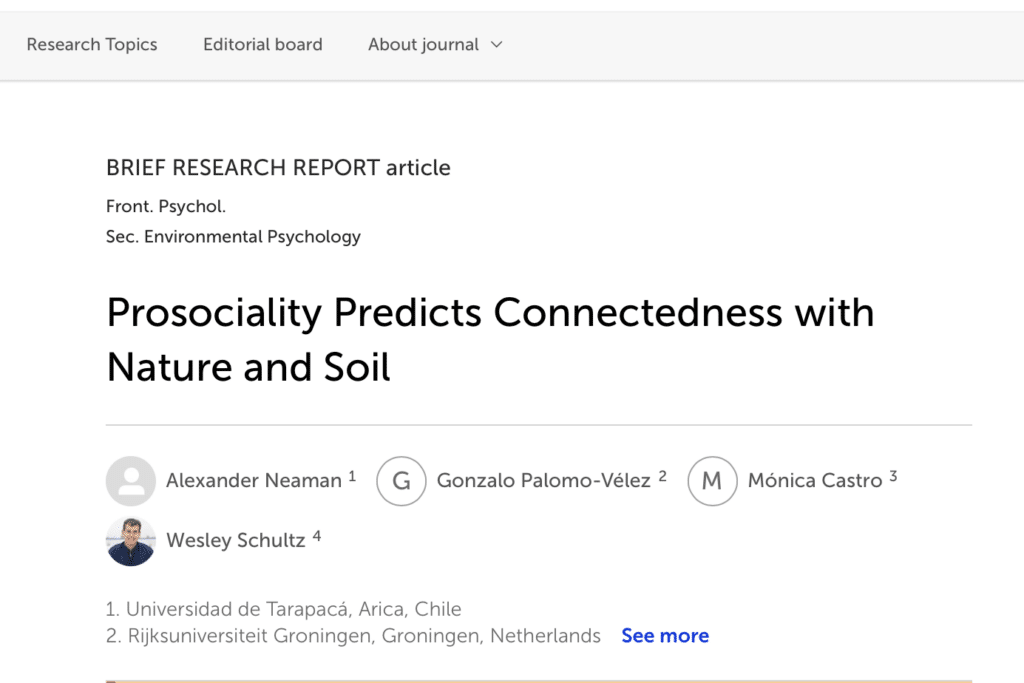
Prosociality Predicts Connectedness with Nature and Soil

The main objective of this study was to examine the relationship between prosocial propensity and soil connectedness in a sample of Chilean farmers.

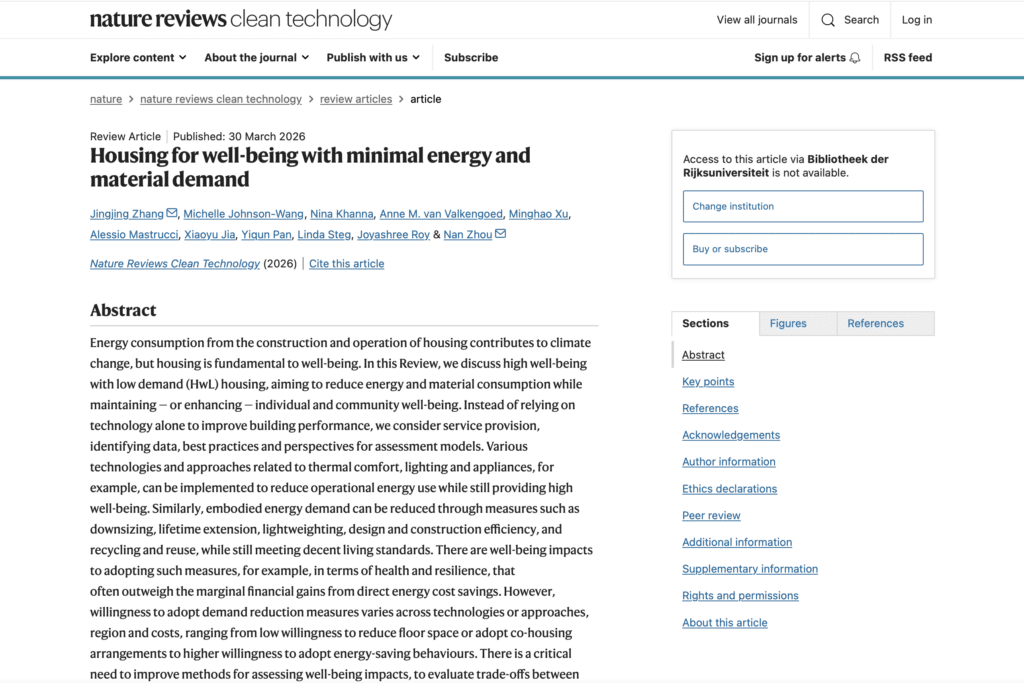
Housing for well-being with minimal energy and material demand

In this Review, we discuss high well-being with low demand (HwL) housing, aiming to reduce energy and material consumption while maintaining — or enhancing — individual and community well-being.

Featured publications

Prosociality Predicts Connectedness with Nature and Soil

The main objective of this study was to examine the relationship between prosocial propensity and soil connectedness in a sample of Chilean farmers.

Housing for well-being with minimal energy and material demand

In this Review, we discuss high well-being with low demand (HwL) housing, aiming to reduce energy and material consumption while maintaining — or enhancing — individual and community well-being.

Climate policy feasibility across Europe relies on the conditional middle

The preferences of conditionals hinge upon specific policy instruments and the perceived cost–benefit balances but less on fixed ideology or demographics.

The behavioral dimension of transport decarbonization

Drawing on an interdisciplinary workshop, this paper emphasizes integrating behavioral insights into climate policy design to ensure technical effectiveness, social acceptability, and equity.

Circular citizenship behaviours to promote systemic change: Influences of values, beliefs, norms, and personal agency

Our findings highlight much untapped potential for systemic change through citizen action and offer insights into how engagement in Circular Citizenship Behaviours (CCBs) might be promoted.

An opinion dynamics approach to model and analyze the behavior of consumers in an energy network

Motivated by theories and evidence from the social psychology literature, we propose a novel continuous-time mathematical model that captures the evolution of motivation and behavior of energy consumers in a social network.

A deep dive below the human surface: The effect of basic human values on coastal residents’ and tourists’ marine personal norm, mediated by marine value orientations

This research enhances theoretical understanding of how basic human values and value orientations relate to each other and to feelings of responsibility to protect marine environments. In addition, it provides practical insights for engaging the public in marine conservation efforts.

Restoring landscapes to build common futures: Land redistribution and environmental action in rural Scotland

By centering local agency, affective ties to place, and democratic governance, restorative commoning offers a pathway for more inclusive and sustainable approaches to landscape revitalisation.
Engagement of citizens in energy governance: unravelling participatory capital for energy sufficiency in France and the Netherlands

We developed the “Participatory Capital Framework” to illustrate the willingness and ability of citizens to participate in energy decision-making and stimulate energy efficiency and sufficiency strategies.
Forest or machine? Public perceptions and acceptability of negative emissions technologies and practices across six European countries

We conducted a large scale survey on NETPs in six EU countries (N = 5,310) to examine: (1) public preferences for NETPs, next to other mitigation options; (2) how people evaluate the environmental and intergenerational consequences and acceptability of nature-based (i.e., afforestation and reforestation; AR) and technology-based NETPs (i.e., direct air capture with carbon storage; DACCS); (3) the relationship between the evaluation of consequences and acceptability judgements of AR and DACCS; and (4) public preferences for AR and DACCS in general versus in their own country.

Integrating AI technologies and citizen science to fast-track small and ectothermic animal monitoring

Our study demonstrates a scalable solution to fast-track widespread monitoring of small and ectothermic animals.

A meta-analytic review of why people save energy at home

Our results show that campaigns that aim to boost energy saving at home should target how capable people feel of saving energy or remind them of the other pro-environmental actions they already do.

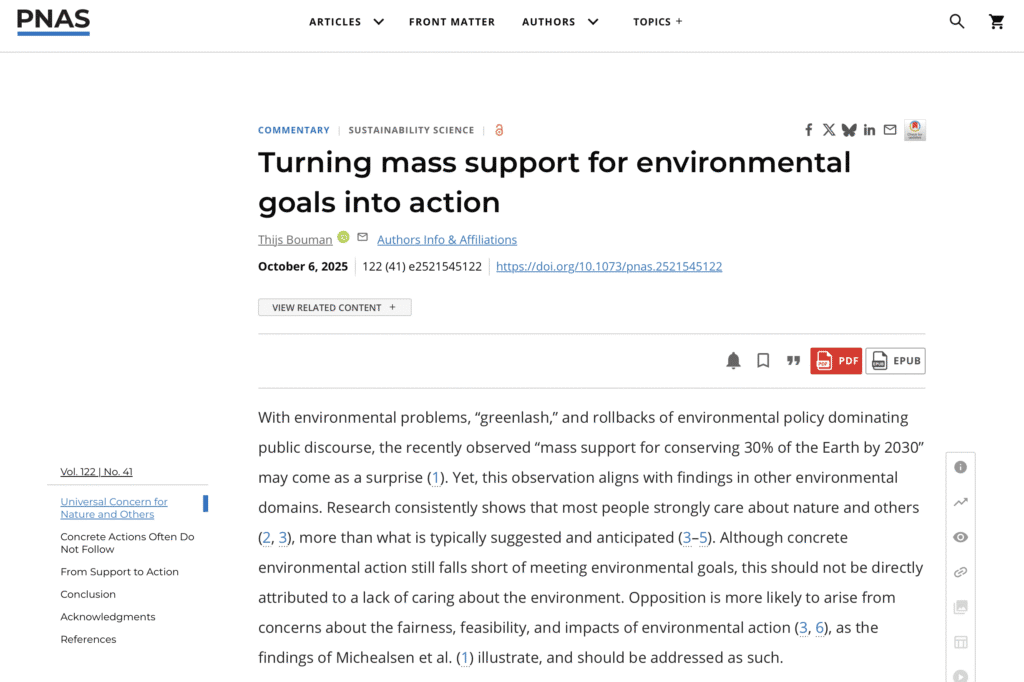
Turning mass support for environmental goals into action

Although concrete environmental action still falls short of meeting environmental goals, this should not be directly attributed to a lack of caring about the environment.

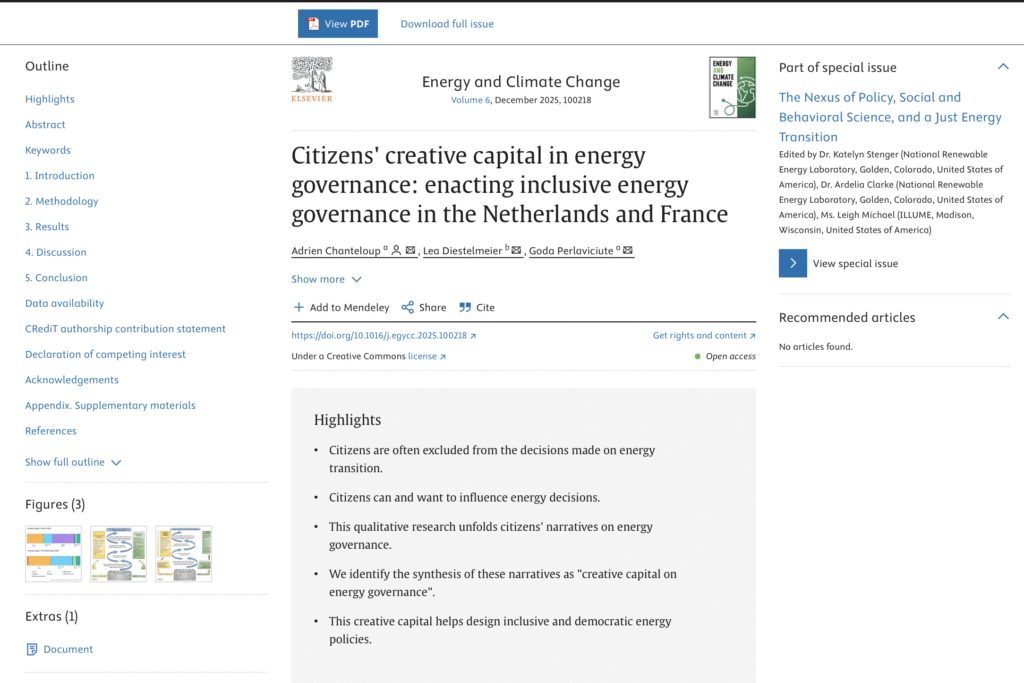
Citizens’ creative capital in energy governance: enacting inclusive energy governance in the Netherlands and France

We identify citizens’ “creative capital” for energy governance and argue that this brings added value for designing energy governance for a more socially, politically and environmentally sustainable energy system.
Entrepreneurs of sustainable identity in groups that value similarity or diversity: trajectories of change

Contrary to prior work suggesting that vegans evoke resistance, our findings demonstrate shifts towards veg*nism in participants' attitudes, behaviors, and biospheric values.

Our publications

Prosociality Predicts Connectedness with Nature and Soil

Housing for well-being with minimal energy and material demand

Climate policy feasibility across Europe relies on the conditional middle

The behavioral dimension of transport decarbonization

Circular citizenship behaviours to promote systemic change: Influences of values, beliefs, norms, and personal agency

An opinion dynamics approach to model and analyze the behavior of consumers in an energy network

A deep dive below the human surface: The effect of basic human values on coastal residents’ and tourists’ marine personal norm, mediated by marine value orientations

Restoring landscapes to build common futures: Land redistribution and environmental action in rural Scotland

Engagement of citizens in energy governance: unravelling participatory capital for energy sufficiency in France and the Netherlands

Forest or machine? Public perceptions and acceptability of negative emissions technologies and practices across six European countries

Integrating AI technologies and citizen science to fast-track small and ectothermic animal monitoring

A meta-analytic review of why people save energy at home

Turning mass support for environmental goals into action

Citizens’ creative capital in energy governance: enacting inclusive energy governance in the Netherlands and France

Entrepreneurs of sustainable identity in groups that value similarity or diversity: trajectories of change

Explaining acceptance and acceptability of connected automated vehicles: the impact of evaluations of attributes and traffic complexity

Design for Behaviour Change — The Influence of Packaging Design on Recycling

Do you trust your policymakers? Effects of competence- and integrity-based trust on perceptions of sustainable food policies in Chile and Germany

How company history and hydrogen type shape public trust and acceptability: A reputation management perspective

Whose job is it to solve climate change? Perceptions of the roles of diverse actors in addressing climate change

Reducing environmental pressure through a more circular consumption of clothes

Understanding the relationship between public participation and public acceptability of climate policies

Circular citizenship behaviors: How individuals can promote systemic change toward a circular economy

What motivates tourists to conserve water on vacation? Examining the role of personal climate-based values

A systematic review of public acceptability and perceived impacts of eleven energy sources and mitigation technologies

Psychological and contextual determinants of clean energy technology adoption

Sustainable energy technology adoption for a low-carbon future: A global meta-analysis of psychological determinants

An Agent-Based Model of the Extinction of Experience: How Nature Availability and Connectedness to Nature Co-Evolve Over Time

Inclusive community energy initiatives? Understanding involvement of different socio-demographic groups

Personal Actions or Systemic Solutions: How The Focus of the Conversation Influences Willingness to Talk about Environmental Issues

Local fossil fuel ad ban as a catalyst for global change

Temporal stability of public acceptability of novel and established energy technologies

A critical reflection on behavioural difficulty: proposing a barrier-first approach

Values at Work: Understanding the Relationship of Individual and Perceived Organisational Values on Employees’ Motivation and Pro-Environmental Behaviour at Work

Climate action on Twitter: perceived barriers for actions and actors, and sentiments during COP26

People’s perception of biodiversity loss: Validation of a scale in Germany

Good intentions, limited action: when do farmers’ intentions to adopt sustainable farming practices turn into actual behaviour?

‘Yes, we care’: pro-environmental social identity framing to promote acceptance of decentralized wastewater treatment systems

The climate anxiety compass: A framework to map the solution space for coping with climate anxiety

The public demands more climate action, not less

Social Tipping Games: Experimental Paradigms for Studying Consumer Movements

Unveiling citizens’ perspective on citizen assemblies among participants and non-participants of a citizen assembly on energy

How bottom-up and top-down governance of community energy initiatives affects citizens’ perceptions, acceptability, and willingness to join

A social network approach to community energy initiative participation

Responsible carbon dioxide removals and the EU’s 2040 climate target

Are we on the same page? Understanding value similarity and its impact on public trust in institutions of the energy sector

Citizen assemblies should involve citizens as experts on their own values

Energy citizenship as people’s perceived (collective) rights and responsibilities in a just and sustainable energy transition – scale development and validation

Do I Perceive That We as a Community Can Persist, Adapt Flexibly, and Positively Transform? The Relationship Between Collective Transilience and Community-Based Adaptation

Perceived distributive fairness and public acceptance of a policy mandating on-site wastewater treatment and reuse

Accelerating social tipping points in sustainable behaviors: Insights from a dynamic model of moralized social change

Consumer resistance diminishes environmental gains of dietary change

Trusting the minister or trusting the mayor? Perceived competence and integrity of central and local Dutch institutions governing energy matters

Tasting and labeling meat substitute products can affect consumers’ product evaluations and preferences

Public opinion about solar radiation management: A cross-cultural study in 20 countries around the world

Acceptability of connected automated vehicles: Attributes, perceived behavioural control, and perceived adoption norm

Exploring energy geography: Data insights on household consumption

Circular consumption to reduce environmental pressure: Potential of behavioural change in the Netherlands

Exploration of children’s value patterns in relation to environmental education programmes

Individual Transilience in the Face of the COVID-19 Pandemic

Climate anxiety is not a mental health problem. But we should still treat it as one

Are we on the same page? Exploring the relationships between environmental values, self-identity, personal norms and behavior in parent-adolescent dyads

The group dynamics sparking social change: how group value in diversity predicts interactions with a deviant

Time to talk about values, time to say no: What drives public participation in decision-making on abstract versus concrete energy projects?

Climate Anxiety: A Research Agenda Inspired by Emotion Research

From believing in climate change to adapting to climate change: The role of risk perception and efficacy beliefs

Climate anxiety is about more than just personal risks

Gendered geography of energy consumption in the Netherlands

Which policy measures can motivate active mobility in rural and semi-rural areas?

The psychological distance of climate change is overestimated

Environmental Decision-Making in Times of Polarization

The role of partners, parents and friends in shaping young women’s reproductive choices in Peri-urban Nairobi: a qualitative study

An interdisciplinary understanding of energy citizenship: Integrating psychological, legal, and economic perspectives on a citizen-centred sustainable energy transition

Can we do more than “bounce back”? Transilience in the face of climate change risks

Cooking a pro-veg*n social identity: the influence of vegan cooking workshops on children’s pro-veg*n social identities, attitudes, and dietary intentions

An Integrated Human–Cyber–Physical Framework for Control of Microgrids

The importance of user acceptance, support, and behaviour change for the implementation of decentralized water technologies

When others control risks: Others-focused coping with risks from energy projects

Trust in institutions and public acceptability of risky energy production: Testing the causal relationships in the context of Groningen earthquakes

De Gruyter Handbook of Sustainable Entrepreneurship Research

Context matters: The role of perceived ease and feasibility vis-à-vis biospheric values in recycling behaviour

A social network perspective on involvement in community energy initiatives: The role of direct and extended social ties to initiators

A method to identify barriers to and enablers of implementing climate change mitigation options

To select effective interventions for pro-environmental behaviour change, we need to consider determinants of behaviour

Opposing out loud versus supporting in silence: who wants to participate in decision-making about energy projects?

Profiles of an Ideal Society: The Utopian Visions of Ordinary People

The politicisation of climate change attitudes in Europe

A spiral of (in)action: Empowering people to translate their values in climate action

The Importance of Institutional Capacity and Negotiation Capacity in Affordable Housing Agreements: The Potential for Collective Action in Melbourne, Australia

Is virtual reality a valid tool for restorative environments research?

Use of digital media for family planning information by women and their social networks in Kenya: A qualitative study in peri-urban Nairobi

Distributed control of DC grids: Integrating prosumers’ motives

Corporate environmental responsibility leads to more pro-environmental behavior at work by strengthening intrinsic pro-environmental motivation

Unequal means more unfair means more negative emotions? Ethical concerns and emotions about an unequal distribution of negative outcomes of a local energy project

Designing for value-behaviour consistency: ethical choice architecture to stimulate sustainable meat purchase

What influences public acceptability of sustainable energy policies? The crucial role of funding and who benefits

Adding Dynamic Norm to Environmental Information in Messages Promoting the Reduction of Meat Consumption

Relationships between climate change perceptions and climate adaptation actions: policy support, information seeking, and behaviour

The role of trust in public acceptability of energy projects: Integrity versus competence

When you choose but not lose: Decreasing people’s desire for options on technological appliances

The impact of COVID-19 related regulations and restrictions on mobility and potential for sustained climate mitigation across the Netherlands, Sweden and the UK

The Role of Community in Understanding Involvement in Community Energy Initiatives

Towards Circular Economy for More Sustainable Apparel Consumption: Testing the Value-Belief-Norm theory in Brazil and in The Netherlands

Are subsidies for climate action effective? Two case studies in the Netherlands

Dietary behaviour as a form of collective action: A social identity model of vegan activism

De rol van menselijk gedrag is cruciaal voor een soepele landbouwtransitie

Leveraging emotion for sustainable action

Minority influence in climate change mitigation

The effects of a financial incentive on motives and intentions to commute to work with public transport in the short and long term

Demand-side solutions to climate change mitigation consistent with high levels of well-being

Promoting energy sources as environmentally friendly: does it increase public acceptability?

The more public influence, the better? The effects of full versus shared influence on public acceptability of energy projects in the Netherlands and China

Contested climate policies and the four Ds of public participation: From normative standards to what people want

Values in the backyard: The relationship between people’s values and their evaluations of a real, nearby energy project

Pro-environmental behaviour and support for environmental policy as expressions of pro-environmental motivation

My company is green, so am I: the relationship between perceived environmental responsibility of organisations and government, environmental self-identity, and pro-environmental behaviours

From toilet to table: Value-tailored messages influence emotional responses to wastewater products

I Am vs. We Are: How Biospheric Values and Environmental Identity of Individuals and Groups Can Influence Pro-environmental Behaviour

Is an Appeal Enough? The Limited Impact of Financial, Environmental, and Communal Appeals in Promoting Involvement in Community Environmental Initiatives

Engaging city residents in climate action: Addressing the personal and group value-base behind residents’ climate actions

Insights from early COVID-19 responses about promoting sustainable action

Why Dutch officials take bribes: a toxic mix of factors

The Normative Route to a Sustainable Future: Examining Children’s Environmental Values, Identity and Personal Norms to Conserve Energy

Moral hypocrisy and the hedonic shift: A goal-framing approach

Limiting climate change requires research on climate action

Can community energy initiatives motivate sustainable energy behaviours? The role of initiative involvement and personal pro-environmental motivation

Beyond purchasing: Electric vehicle adoption motivation and consistent sustainable energy behaviour in The Netherlands

Measuring Values in Environmental Research: A Test of an Environmental Portrait Value Questionnaire

Emotional Responses to Energy Projects: Insights for Responsible Decision Making in a Sustainable Energy Transition

Corruption in Organizations: Ethical Climate and Individual Motives

Consumer Behavior: Why Engineers Need to Read About It [Guest Editorial]

Changing Household Energy Usage: The Downsides of Incentives and How to Overcome Them

At the Heart of a Sustainable Energy Transition: The Public Acceptability of Energy Projects

A Part of the Energy “In Crowd”: Changing People’s Energy Behavior via Group-Based Approaches

Find out more about our educational programme

Got questions?
Contact us!