Just over a year ago, the municipality of The Hague became the first in the world to pass a law banning ads for fossil fuel products and services – petrol, diesel, aviation, cruises, fossil energy contracts, hybrid and combustion-engine cars – from the streets of their city.
“It’s a ban on advertisements for products and services with a strong fossil or carbon footprint, which are products and services that have a big impact on the environment and climate change”, according to associate professor of environmental psychology Thijs Bouman in a podcast conversation about the ban.
Sparking debate
 “Fossil advertisements normalise [such] products and their consumption” Bouman says. The proliferation of ads for cheap air holidays and cruises can lull us into thinking that everyone does it, and can leave people who are trying to live more sustainably feeling like their efforts won’t amount to much against that critical mass of high emissions behavior.
In a 2025 paper about the ban by Bouman and co-authors Jan Willem Bolderdijk and E. Keith Smith, the researchers stated that it could spark a wider societal debate, challenge current fossil-intensive consumption norms and conventions, and set an example for other legislators.
The authors also discovered ample potential for rolling out similar bans across the EU: only 25% of survey respondents in 13 European Union nations were opposed to such a ban.
A growing movement
The BBC reports that Saint-Gilles in Belgium, Stockholm in Sweden and the Italian city of Florence have taken up their own versions of laws to limit or prevent emissions-intensive ads in public spaces.
Outside of Europe, World Without Fossil Ads – a site tracking proposed and accepted bans on fossil ads – shows that cities in South Africa, Australia, New Zealand and Canada have adopted local bans as well.
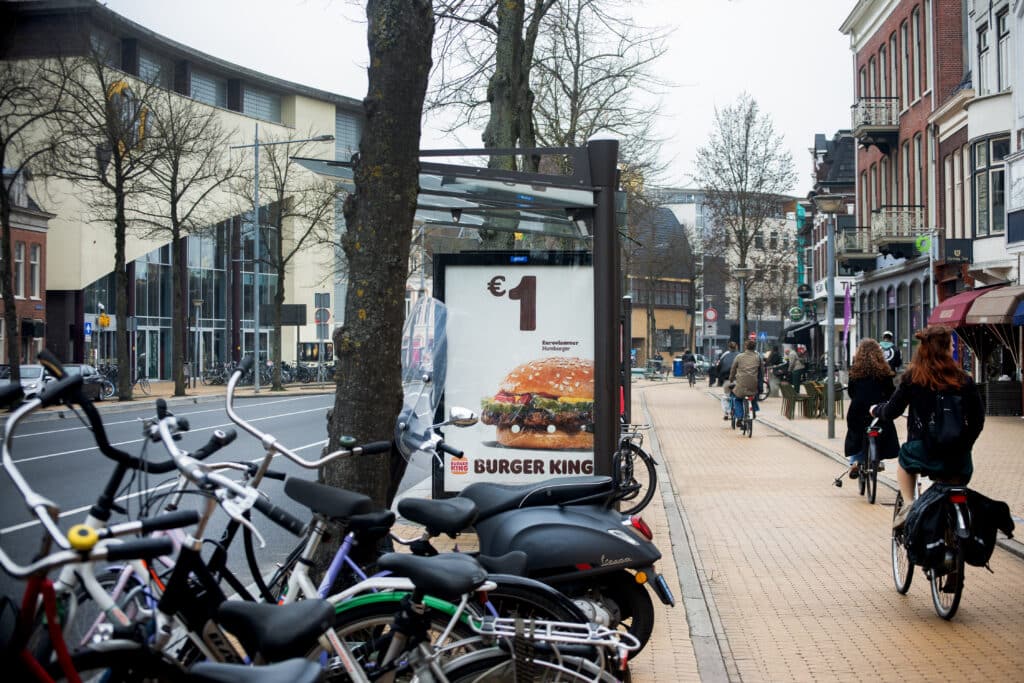
It is a growing movement in the Netherlands, too: in January, Groningen became the tenth Dutch municipality to vote for banning ads for fossil fuel-intensive industries in public spaces. Amsterdam also recently adopted a similar law prohibiting such advertisements, and at least 14 other Dutch municipalities are either in the process of implementing their own local bans, or have already made public ads for cheap flights and fast food chains a thing of the past.
Normalisation machine
Reint-Jan Renes, a sustainable behavioral psychology lecturer at the Hogeschool van Amsterdam, co-authored a report along with Bouman (and others) which was part of the case for The Hague fossil fuel ban in 2023. When Amsterdam voted to stop allowing ads for emissions-intensive products and services, Renes made the point that advertising is a normalisation machine. “It’s not a neutral announcement that a certain product exists. Ads continually communicate to us what is seen as normal, preferable and a given.”
Renes says that the advertising ban can help to break through the current status quo “by going against the normalisation of polluting behavior, correcting social misperceptions and creating more space for the visibility of sustainable alternatives.”
Challenging legitimacy
In their 2025 paper, Bouman, Bolderdijk and Smith say that the original ban in The Hague sent out a powerful message by explicitly rejecting the normalization of fossil fuel products and services.
The signal value of local government decisions can be powerful, the authors write, because they are “often assumed to represent the wider contemporary societal values.” Elected officials who vote in favor of these bans suggest that they see promoting fossil fuel products goes against their constituents’ norms.
The Hague ban also “challenges the taken-for-granted nature and moral legitimacy of fossil fuel products and services, communicates their societal and environmental harms, and clearly indicates that promotion in the public sphere will not be tolerated.”
National ban?
As the number of local bans continues to grow, the likelihood of a nation-wide ban also seems to be increasing. In fact, on 3 March, the Dutch parliament voted on two motions regarding a national ban on public fossil fuel ads: one against a ban by Henk Vermeer of the BBB, and one in favour by Christine Teunissen (PvdD), Sjoukje van Oosterhout (GL-PvdA), and Laurens Dassen (Volt).
Neither of the motions passed, but the regularity of the matter appearing on the legislative agenda seems to be an indication of the growing attention to the issue in Dutch society.

Symbols matter
One point that has been raised by skeptics of these bans is that they are just symbolic. The authors strongly argue against dismissing them on those grounds, arguing that ads themselves rely on the power of symbols, and that symbols are how societal change begins.
“This ban has a very powerful symbolic function as well, and I think by expanding this ban can motivate others to do the same”, Bouman says. “It can substantially impact these dynamics and how we perceive fossil-based products or fossil intensive products, and contribute to this transition towards a more sustainable or climate friendly society.”
Banning ads for fossil-based products and services is a necessary step toward normalising more sustainable consumption. Changing norms is essential to creating a context that enhances the acceptability of other climate measures and enables them to have the desired effect.