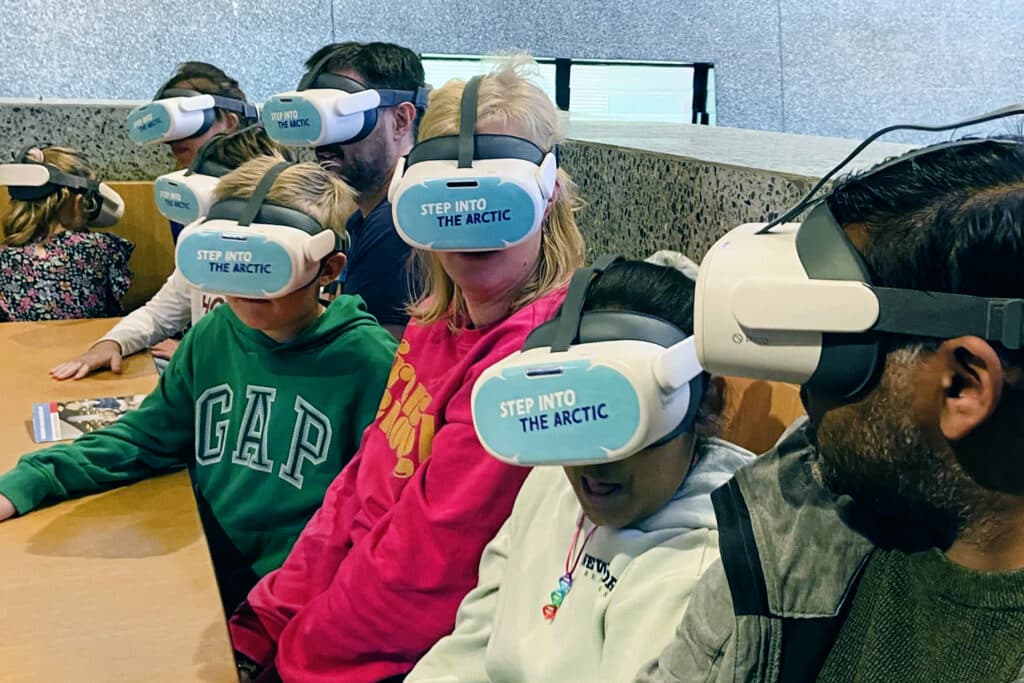
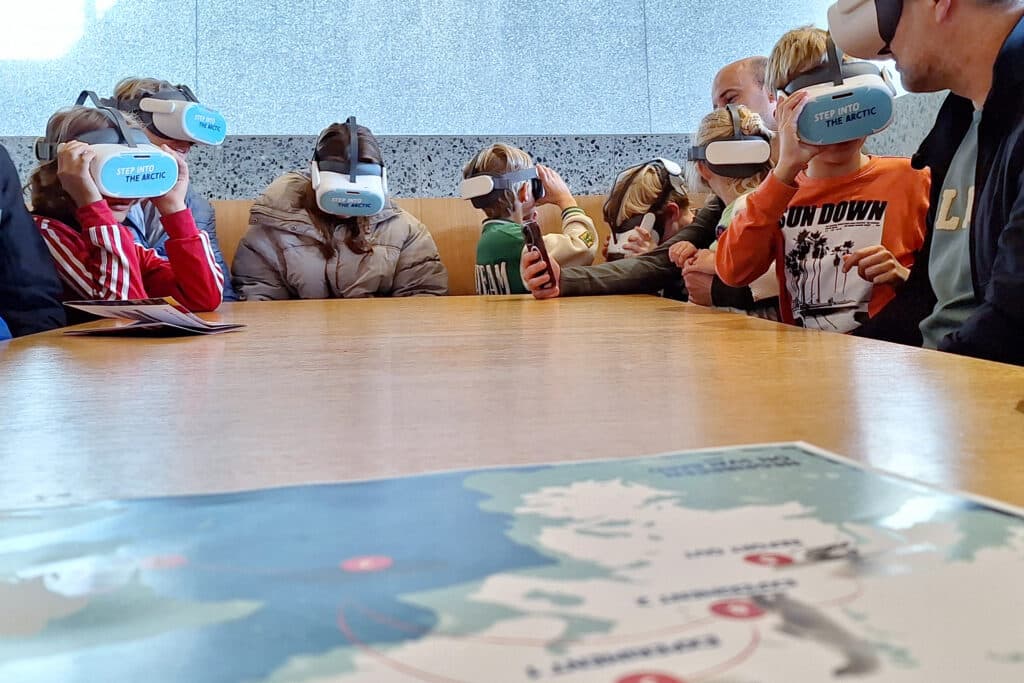
On an ordinary Sunday in October, during the Science Week at Utrecht University, a small queue formed inside one of the university buildings. Parents stood behind their children, children bounced slightly on their toes, not for a lecture, not for a lab demonstration, but for a journey. A journey with a virtual reality headset.
One by one, people put it on. And within seconds, they were no longer standing in a university hall. They were in the Arctic.
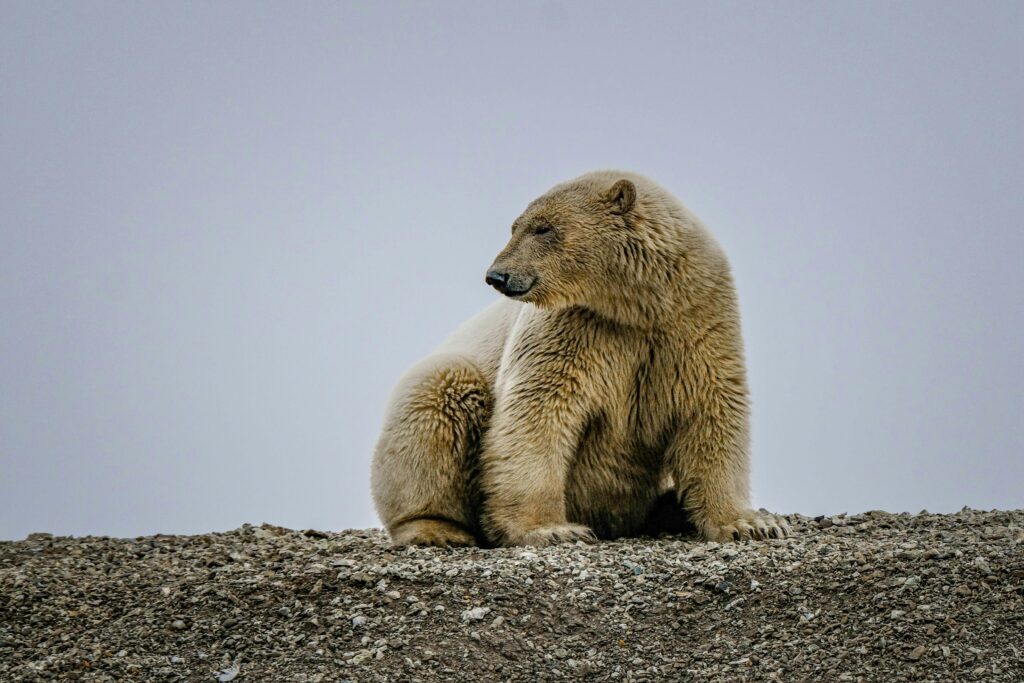
In its place came an expanse of white, endless ice stretching toward a pale horizon. The Arctic unfolded in silence. A polar bear moved across the frozen landscape. The air felt vast, quiet, fragile. For a few minutes, the Arctic wasn’t an abstract place on a map. It was real.
When they removed the headset, something subtle had shifted.
Three simple questions
Instead of asking what they had learned, we handed them a postcard with three unfinished sentences:
- ‘Right now, I feel…’,
- ‘I hope that…’,
- ‘This is what I want to do to help care for the Arctic…’.
We received 163 responses, from children as young as four to adults in their sixties. What they wrote tells a story about how we experience the same world differently.
Read the full report about the Arctic Explorer VR experiment at Science Week at Utrecht University
Emotional responses: Wonder for the young, responsibility for the grown
The youngest participants grabbed markers eagerly. Many of them wrote quickly, in large, confident letters. ‘Happy.’ ‘Excited.’ ‘Amazed.’ For them, the Arctic had been an adventure: vast, bright, extraordinary. It was a place of polar bears and endless snow, a world unlike their own.
While children expressed more positive emotions, adults often paused before writing and showed a more mixed emotional pattern, with fewer positive feelings and noticeably more negative emotions (sad, worried, bad). A few admitted to feeling ‘guilty’. Mixed responses such as ‘inspired and worried’ or ‘full of mixed emotions, a bit sad’ appeared almost exclusively among adults. They had seen the same landscapes as their children, but they seemed to experience them through a different lens. The Arctic was not just beautiful; it was vulnerable. Its silence carried urgency.
Hope looks different at every age
After writing how they felt, participants moved to the second sentence: “I hope that…”
This is where something subtle happened.
Children’s hopes were immediate and heartfelt. Many wished they could ‘experience the VR again’ and they could ‘go to the Arctic in real life’. But most of all, they hoped for the animals…the polar bears. They wrote that they hoped ‘polar bears would survive’, ‘that the ice wouldn’t melt’, ‘that the North Pole would stay cold’. Their hopes were vivid and concrete. The Arctic, to them, was not a policy issue. It was a place that needed to stay as it was: frozen, alive, protected.
Adults wrote differently. Their hopes stretched beyond the landscape itself. Yes, they hoped the ‘ice would remain’ and ‘the animals would endure’. But they also wrote about humanity. They hoped ‘climate change would slow down’. They hoped “we” would change. They hoped society would make better choices. Some expressed cautious optimism, ‘I hope it’s still there’, a sentence that carries both longing and doubt.
Children hoped for outcomes. Adults hoped for change.
And in that distinction lies something important. Hope revealed how each group understood the problem. For children, the Arctic was something to save. For adults, it was something connected to systems, behaviors, and collective responsibility.
Hope became the bridge between feeling and action. It showed that the experience had moved beyond awe.
Intended actions
Children’s tone became unexpectedly thoughtful when asked about ‘This is what I want to do to help care for the Arctic’. They wrote about ‘turning off lights’, ‘taking shorter showers’, ‘biking more’, ‘eating less meat’. The connection between their everyday habits and that distant frozen world had formed almost instinctively. Some responses were tender and direct: they wanted to ‘hug the polar bears’, ‘feed them fish’, ‘make sure they had enough to eat’. The animals were no longer symbols of climate change; they were beings they had encountered.
And then came the imaginative leaps only children can make. One suggested ‘shooting the sun’. Another proposed ‘making more ice at the North Pole’. Someone wanted to ‘invent a machine that could remove heat from the Earth’. These weren’t misunderstandings, they were expressions of creative problem-solving applied to a real problem children genuinely care about. Children responded with a mix of practical awareness, emotional connection, and imaginative thinking, actively constructing a response to a complex problem using every tool available to them.
Adults wrote about ‘driving less’, ‘flying less’, ‘consuming more consciously’. Some mentioned ‘voting differently’, ‘supporting environmental organizations’, ‘contributing to research’. Several spoke about influencing others: ‘teaching their children’, ‘inspiring friends’, ‘passing the message along’. Their responses moved beyond personal habits into systems and structures. Where children connected emotionally to a polar bear, adults connected ethically to a global problem.
What was striking was not which group cared more. Both cared deeply. The difference lay in how they carried that care.
The Arctic is geographically distant from the Netherlands, but through the lens of a VR headset, that distance evaporated. The ice was no longer an abstract statistic about melting rates; it became a tangible environment shared in real-time. By leveraging immersive technology, the Arctic was brought into the room, allowing the VR simulation to perform a unique kind of ‘internal work’ on different minds.
For children: The virtual environment built wonder first. This digital immersion opened the door to empathy, leading to small, concrete intentions.
For Adults: The experience activated deep reflection. Seeing the vulnerability of the ecosystem in 360 degrees stirred a sense of responsibility that translated into structured commitments: personal, political, and collective.
The key takeaway
Change does not always begin with more information. Sometimes it begins with virtual presence; the ability to stand in a landscape we would otherwise never reach. Through a headset, we can feel the beauty and fragility of the Arctic without adding to the heavy footprint of rising tourism in these sensitive regions. It’s about more than just seeing a place; it’s about realizing, from our own living room, how deeply our life is connected to it.
As we look for new ways to engage the public in the climate crisis, immersive learning proves to be a powerful tool for building both imaginative empathy in the next generation and reflective responsibility in the current one.
The Open Question
These findings are based on immediate, self-reported intentions. Will they translate into long-term behavioral change?
That remains the next research frontier.
Read the full report about the Arctic Explorer VR experiment at Science Week at Utrecht University